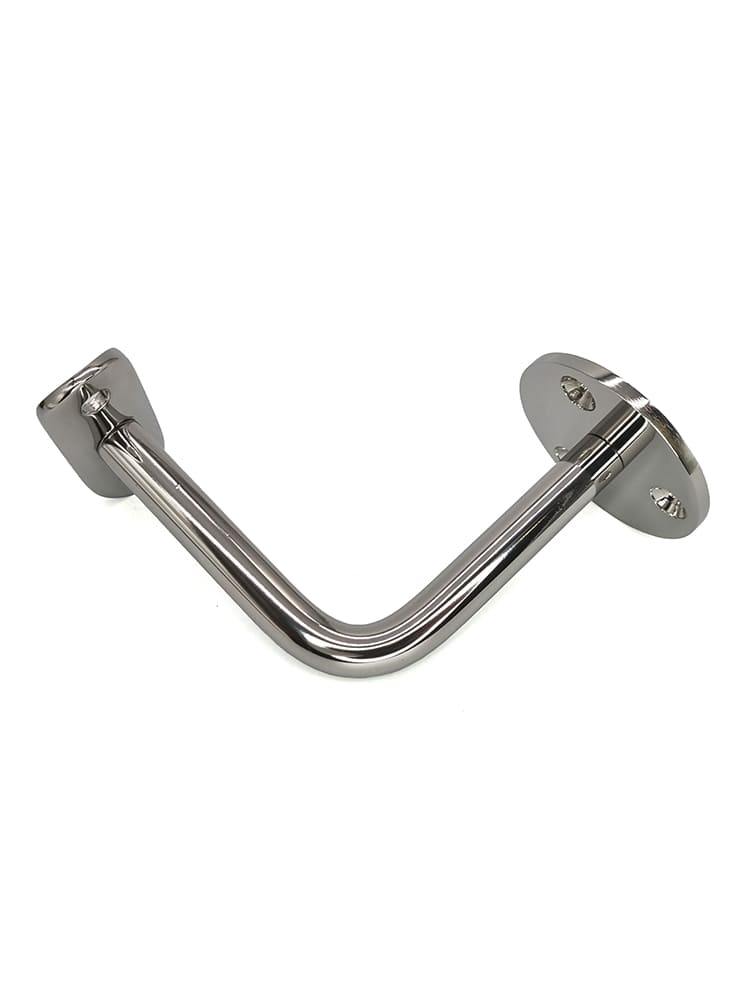
Railing and handrail fasteners are special elements used for reliable installation of railings, handrails or fences. They provide fixation of structures on walls, floors, flights of stairs or other surfaces, and also increase stability and safety.
ODF confidently occupies a leading position among manufacturers of railing and handrail fasteners. We create products that harmoniously combine exceptional quality, reliability and stylish design. Our mission is to ensure maximum safety and ease of use of products in a variety of conditions.
Thanks to modern production facilities, we produce a wide range of products, adapting to any customer requests. Using the latest technologies and innovative approaches, we achieve high durability and aesthetic appeal of each element. Our team of engineers and designers constantly improves products, introducing advanced developments and materials to offer solutions that exceed expectations.
Our range of handrail fastenings covers the most common installation and finishing options, allowing you to choose the best solution for any task.
These are ideal for modern interiors, where clear geometric lines prevail. They provide reliable fixation of a square handrail and harmoniously combine with other elements of the railings.
This is a universal solution for most standard handrails. Suitable for classic and modern designs, easy to install and provide a high strength connection.
Provide an aesthetic and reliable connection of handrails to glass railings. They emphasize the lightness of the structure, without visually overloading it, and are suitable for modern design solutions using glass.
These are durable and easy-to-install elements that provide reliable fastening of handrails directly to the wall surface. Suitable for stairs, balconies and other structures that require wall mounting.
These are standard fasteners with a fixed height, ideal for simple and proven design solutions where there is no need to adjust the height of the handrail.
With the ability to adjust the height of the handrail, they allow you to accurately set the height of the handrails to specific requirements, ensuring maximum accuracy and comfort when using the structure. They are especially convenient on complex surfaces and non-standard staircase structures.
Processed by grinding and then polishing the surface of the product to a mirror shine. This process involves sequential processing with different abrasive materials, ranging from coarse to ultra-fine, to remove all microscopic irregularities and give the surface smoothness. Polished fittings have an elegant and luxurious look that emphasizes the modern style of interiors. It reflects light well, creating the effect of visually increasing the space, but requires more careful maintenance to maintain the shine.
Creating a matte metal surface is a process in which the rough texture turns into a soft, uniform effect due to the treatment with abrasive materials. The metal is pre-cleaned from dirt and oxides to prepare it for grinding. Abrasives of different grain sizes gradually remove the top layer, forming a uniform surface. Uniform movements of the tool help to avoid overheating and local defects, and fine-grained abrasives at the final stage give the surface a muted shine. The matte texture is the result of a subtle play of light on microscopic irregularities, creating an effect of sophisticated elegance and discreet aesthetics. Also, the matte surface has advantages, since fingerprints and scratches are less visible on it.
Achieved by applying a powder composition to the surface, which is then baked in a special chamber at a high temperature. This method provides a uniform coating and high resistance to mechanical damage, corrosion and chemical influences. The black finish creates a stylish and modern look, ideally combined with loft design, industrial interiors and accent elements. It is not only aesthetically pleasing, but also practical, as fingerprints and small dirt are less visible on the matte black surface.
Each of these types of finish allows you to choose the best option for a specific style and operating conditions, ensuring durability and a presentable appearance of the product.
Stainless steel is used in the production of fittings and structures due to a unique combination of properties that make it an ideal material for many tasks. Its key advantage is corrosion resistance. This is achieved due to the chromium content in the alloy, which, when interacting with oxygen, forms a protective oxide layer on the surface. This layer prevents the destruction of the metal even in conditions of high humidity, in contact with chemicals or in an aggressive environment.
In addition, stainless steel is characterized by high mechanical strength, which makes it a reliable choice for structures subject to heavy loads or constant use. Its surface retains an aesthetic appearance even after years of use, due to its resistance to scratches and damage. It is also important that this material is easy to process, which allows you to create products with a variety of finishes - from mirror polish to matte texture, emphasizing style and functionality.
The environmental component also plays a role. Stainless steel is completely recyclable, which makes it a more sustainable choice in terms of environmental protection. As a result, this material combines durability, practicality and aesthetic appeal, which makes it indispensable in modern designs and interiors.